Brand Guidelines 2026

Integrative Psych

Life-changing therapy, delivered with precision and warmth.

Chelsea, NYC Miami, FL Bozeman, MT
01

Brand Story &
Positioning

The Thinking Person's Mental Health Practice

Integrative Psych was built on a conviction: that the best care doesn't come from a single modality, a single school of thought, or a single size that fits all. It comes from precision. From listening before prescribing. From integrating the biological, the psychological, the sociological, the spiritual, and the environmental into a coherent, collaborative treatment plan.

Founded by Dr. Ryan Sultan — dual board-certified psychiatrist, Columbia University researcher, and second-generation mental health clinician — Integrative Psych occupies rare ground: the rigor of academic medicine without its distance, the warmth of private practice without its limitations.

Three locations. Three distinct communities. One unflinching standard of care.

"No psychotherapy or medication is a cure-all. Different treatments are appropriate for different people in different situations."
— Dr. Ryan Sultan, Founder

Core Brand Promise

Life-changing therapy, delivered with precision and warmth.

Brand Positioning

Where academic rigor meets genuine human warmth. Where evidence-based practice meets individualized care. Where the complexity of the mind is met with both scientific clarity and profound respect.


The Five Pillars

Biological
Psychological
Sociological
Spiritual
Environmental

Brand Personality

Expert Warm Precise Hopeful Grounded Accessible
03

Color Palette

Primary Colors

Deep Current
#1E3A4C
RGB 30 58 76
Pantone 303 C
CMYK 61 24 0 70
Trust, stability, clinical authority. The backbone of the brand.
Warm Sand
#E8B87D
RGB 232 184 125
Pantone 7509 C
CMYK 0 21 46 9
Human warmth, approachability. The heart of the brand.
Canvas
#FDFCFA
RGB 253 252 250
Pantone 9121 C
CMYK 0 0 1 1
Primary background. Breathing room. Never pure white.

Secondary Colors

Clay
#C67B5C
RGB 198 123 92
Pantone 7526 C
CTAs, highlights, urgency with warmth. Grounding and earthy.
Sage Mind
#9CAF94
RGB 156 175 148
Pantone 5575 C
Environmental & spiritual pillars. Restful, organic balance.
Soft Stone
#F5F3F0
RGB 245 243 240
Pantone 9180 C
Alternate background. Section breaks. Always warm-toned.
Charcoal
#3D3D3D
RGB 61 61 61
Pantone 419 C
Body text. Softened black for extended reading comfort.

Color Usage Ratio — The 60 / 30 / 10 Rule

60% — Backgrounds
30% — Structure
10%
60% — Foundation

Canvas (#FDFCFA) and Soft Stone (#F5F3F0) as backgrounds. Alternating these creates gentle visual rhythm without heavy lines.

30% — Structure

Deep Current (#1E3A4C) for headlines, nav, footers, primary text structures, and dark-mode sections. Charcoal for body copy.

10% — Accent

Warm Sand and Clay for calls-to-action, highlights, icons, and brand moments. Use sparingly — scarcity gives them power.

Accessibility Note

All text must meet WCAG 2.1 AA contrast standards. Deep Current on Canvas achieves 11.2:1 ratio. Charcoal on Canvas achieves 8.7:1. Never use Warm Sand or Sage as text on white — use them only as backgrounds or decorative elements.

04

Typography System

Primary Typeface — Montserrat

Aa
ABCDEFGHIJKLMNOPQRSTUVWXYZ
abcdefghijklmnopqrstuvwxyz
0123456789 !@#$&

Montserrat's geometric structure with humanist warmth makes it ideal for medical-adjacent brands that need authority without coldness. Use Light (300) for large display text, Regular (400) for UI, Medium (500) for emphasis. Avoid weights above 600.

Secondary Typeface — Source Serif 4

Aa
Designed for optimal screen readability at all sizes. The italic carries emotional depth—use it for pull quotes, callouts, and moments requiring warmth.

Type Scale

Hero
72px / 300 / -0.02em / 1.05
Title
H1
48px / 300 / -0.01em / 1.1
Heading One
H2
32px / 400 / 0 / 1.2
Heading Two
H3
13px / 600 / 0.12em / 1.4
Section Label
Body
16px / 300 / 0 / 1.75
Body copy text
Caption
11px / 500 / 0.08em / 1.5
Caption / Label text

Usage Principles

  • Line height: minimum 1.5 for body, 1.7 for long-form reading
  • Maximum line length: 680px / ~75 characters for readability
  • Headlines: slightly open letter-spacing (+0.02em) at large sizes
  • Never exceed 2 typefaces in any single layout
05

Photography &
Imagery Style

Aesthetic Direction

Every photograph should feel like stepping into a perfectly organized, sunlit therapy office. Natural. Unhurried. Intentional. The camera always seeks the light—diffused, warm, never harsh.

Lighting

Natural, diffused daylight exclusively. Soft shadows only—they suggest depth without drama. Golden hour warmth when possible. Never flash, never clinical overhead fluorescence.

Color Treatment

Muted, slightly desaturated with warm undertones lifted. Think film photography—slightly soft grain acceptable. Avoid high-contrast, oversaturated "stock photo" looks. Images should feel lived-in, not staged.

Composition

Generous negative space. Rule of thirds. Asymmetrical balance. Shallow depth of field to soften backgrounds and focus attention. One clear subject per frame.

What to Photograph

Spaces

Empty therapy offices, plants in natural light, organized desks with notebooks, comfortable furniture textures, bookshelves with worn spines. Show the environment of healing, not the act of it.

People

Diverse ages, ethnicities, body types. Authentic, thoughtful moments: looking out windows, writing in journals, walking in each distinct location. Never depict a "therapy session" — no couches + clipboards, no crying, no obvious distress.

Texture & Abstract

Close-ups of linen, wood grain, ceramic, leaves, stones, water ripples, architectural details. These carry emotional resonance without the risk of clinical clichés.

Location-Specific Visual Cues

New York City

Chelsea, Manhattan

Clean architectural lines and Chelsea neighborhood textures. Urban sophistication without grit. Interior shots with city light filtering through large windows. Emphasis on precision and intentionality—the organized mind in an organized city.

Miami

South Florida

Coastal light, airy spaces, tropical plants in terracotta pots. Art deco architectural influences in muted, sun-bleached tones. More white space in compositions. The sense of openness—of breath. Blue sky visible but never garish.

Bozeman

Montana

Mountain silhouettes, natural wood, big sky. Rustic warmth without the cliché—think elevated lodge, not hunting cabin. Natural textures dominant: stone, linen, worn leather, pine. The horizon suggests perspective.

Office Photography Standards

Every office image should communicate the same thing: this is a place where serious care happens, and where you will feel safe. Spaces should look curated but lived-in — not staged, not sterile.

Required Shot List

Reception & Waiting Area

Wide establishing shot from the entrance. Should feel welcoming, unhurried. Include seating, plants, any art on walls. No people in this shot. Natural window light preferred. Capture the transition from outside world to safe space.

Therapy Room — Empty

Two angles minimum: from the doorway (establishing), and from the corner (intimate). Chairs or seating visible but no clinical equipment foregrounded. Books, plants, soft textiles should anchor the frame. Shoot in the hour before golden hour for ideal warmth.

Detail & Texture Shots

Minimum four per location: a plant or floral arrangement, a bookshelf detail, a desk surface (notebook, pen, soft object), and one architectural or material detail unique to that location. Shallow depth of field. These are supporting images — they carry mood, not narrative.

Hallways & Transition Spaces

Shoot toward a light source — a window at the end of a hall, a frosted glass panel, an open door. These images represent the journey, not the destination. Empty of people. Should feel quietly hopeful.

Technical Direction
Time of Day

Morning light (9–11am) or late afternoon (3–5pm) only. Avoid midday harsh overhead light. If the space has limited natural light, supplement with large diffused bounce — never direct flash, never ring lights.

Styling Before You Shoot

Remove visible brand clutter (other companies' items), coffee cups, loose papers. Add a plant or fresh flowers if the space lacks organic elements. Slightly open blinds — never fully closed, never fully open. Fold any throws or blankets deliberately.

Post-Processing

Warm the shadows slightly. Lift the midtones. Reduce clarity by 5–10 points to soften without blurring. Final images should match the brand palette — warm sand and sage tones should be present or complementary in the scene.

Do Not Photograph

Tissue boxes, medication imagery, clinical intake forms, anything that reads as medical rather than therapeutic. Avoid cluttered or disorganized surfaces. Never shoot in fluorescent light.

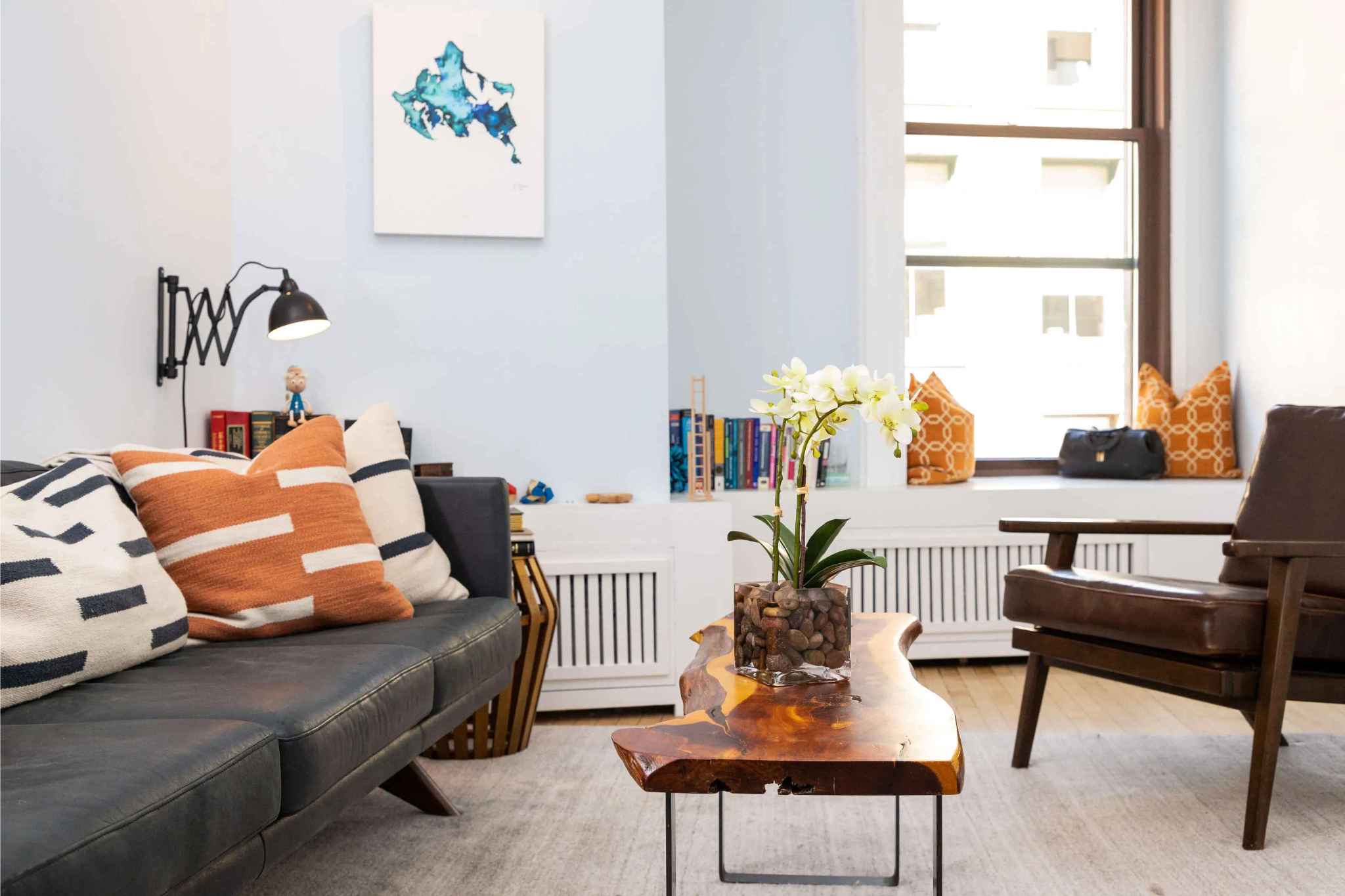
Example — Space Photography
Example office space — therapy room with natural light, leather sofa, live-edge coffee table
Therapy Room · Chelsea NYC
Natural light, live-edge surfaces, organic textiles — curated but lived-in. No clinical equipment in frame.

Staff Photography Standards

Staff photography humanizes the brand without diminishing its clinical authority. Every clinician and team member should look grounded, approachable, and exceptionally competent. The goal is not glamour — it is earned trust.

Headshot Standards

Background

Shot within the office environment — not against a plain studio backdrop. Use a softly blurred therapy room, bookshelf, or window as the background. The environment should be recognizable as Integrative Psych. Consistent across all staff at each location.

Framing & Posture

Head and shoulders to mid-chest. Subject may be seated or standing — both are acceptable if consistent within the same location's team. Slight turn of body toward camera, face forward. Relaxed shoulders. Hands out of frame unless in an environmental shot.

Expression

Warm, genuine — not forced. A closed or barely-open smile is preferred over a full open-mouth smile, which can read as performative. Eyes must be engaged, not glazed. If a subject looks uncomfortable, take a break. Do not use a photo where the person looks stiff or anxious.

Attire

Business casual to professional. Solid colors or subtle patterns only — no bold prints, no busy graphics. Colors should be neutral or align with the brand palette (deep blues, warm neutrals, muted greens). No scrubs, no white lab coats. Clean and deliberate, never sterile.

Environmental & Team Shots
Candid Working Shots

Clinician at their desk reviewing notes, standing near a window in thought, writing — not at a computer. These are not posed but should be lightly directed. Subject should not look at the camera. Conveys presence, reflection, expertise.

Group & Team Shots

Team shots should feel like a gathered group of colleagues, not a corporate lineup. Stagger heights. Allow natural spacing. Shoot outdoors near each location's defining environment (Chelsea street, Miami waterfront, Bozeman landscape) when possible. One team shot per location.

Lighting — All Staff Shots

Natural window light as key light, reflector on fill side only. No ring lights — they create an unnatural catchlight that reads as social media, not clinical. Soft shadows on the face are acceptable and preferred over flat even lighting.

Do Not

Do not over-retouch. Do not remove natural features that define a person's appearance. Do not use a plain white or grey studio backdrop. Do not photograph staff with patients or in any simulated session context. Never use a photo where the subject appears uncomfortable or inauthentic.

Example — Staff Headshot
Example staff headshot — warm, approachable, professionally lit
What this gets right

Neutral background — soft, unobtrusive, never clinical white

Warm, genuine expression — open but not performed

Head and shoulders to mid-chest framing — professional, not corporate

Natural diffused light — soft shadows, no ring light catchlight

Solid neutral attire — clean, deliberate, never sterile

Illustration Language

When illustrations are used, they follow a continuous single-line aesthetic—precise, unbroken, flowing. Derived from the circle motif. Palette matches photography: muted, warm. Never cartoonish. Never literal mental health metaphors (no gears in brains, no sad-to-happy emoji arcs).

Use illustrations for: educational infographics, the Five Pillars visualization, abstract section dividers, patient-facing resource documents.

06

Voice & Tone

Brand Voice Pillars

Expert but Accessible

"We know the research, but we speak human." Lead with clarity, not credentials. When clinical language is necessary, always follow with a plain-language explanation. Never condescend — our patients are intelligent people facing complex challenges.

Warm but Professional

Like a highly skilled clinician on their best day — empathetic, present, with clear expertise and appropriate boundaries. We care, visibly. But we never let warmth blur precision.

Hopeful but Realistic

We do not promise what we cannot deliver. Mental health work is hard, often non-linear, and deeply personal. We acknowledge this honestly. No toxic positivity. Hope is grounded in evidence, not optimism.

Precise but Fluid

Structured in approach, flexible in application. We choose words carefully — each one earns its place. Short sentences. Active voice. Verbs that move.

Tone by Context

Website Copy

Clear, organized, reassuring, authoritative. State what we do, how we do it, why it matters. One idea per sentence. Short paragraphs. Strong verbs.

Clinical Resources

Evidence-based, thorough, careful about claims. Cite sources. Acknowledge complexity. Never overstate outcomes. Write as you would to a brilliant peer who is also your patient.

Marketing / Social

Warm, destigmatizing, community-forward. Share insights, not promotions. Normalize the conversation around mental health without minimizing its difficulty.

Patient Communications

Personal, encouraging, clear action steps. One thing at a time. Never overwhelming. Warm without being saccharine. The reader is facing something difficult — honor that.

Word Choices

Use
treatment plan journey evidence-based collaborative lasting well-being comprehensive
Avoid
fix cure crazy just simply normal failed
"The right words, chosen with care, are themselves a form of treatment. Everything we publish reflects our standard of care."
— Editorial Principle, Integrative Psych
07

Layout & Composition

Grid System

12-Column Grid
Web: 60px margins, 24px gutters
Print: 0.75in margins, 12pt gutters

Spacing Scale

8
16
24
32
48
64
96

All spacing uses multiples of 8. When in doubt, add 20% more white space than feels comfortable.

UI Components

Buttons
Card
Psychological Pillar
Cognitive Behavioral Therapy
Evidence-based treatment addressing the connection between thoughts, feelings, and behaviors.
Form Field
you@example.com

Hierarchy Principles

  • One hero element per page or screen
  • Maximum 3 distinct content blocks above the fold
  • Buttons: pill-shaped (100px border-radius), generous padding (14px 32px)
  • Cards: 8px border-radius, 1px border, subtle shadow only
  • Section breaks via background shifts — never heavy rules or dividers
08

Brand Applications

Business Cards

Dr. Ryan Sultan
Founder & Psychiatrist · Columbia University
integrative-psych.com
hello@integrative-psych.com
Chelsea, NYC · Miami · Bozeman
Front — Deep Current, warm contrast
Back — Logo mark only, Cotton stock

Specifications

  • Size: 3.5" × 2" standard
  • Stock: 32pt Cotton, uncoated
  • Finish: Soft-touch matte
  • Optional: Blind emboss logo on back
  • No rounded corners — clean, precise

Website Homepage

integrative-psych.com
Integrative Psych
Services Locations Team Research Schedule
Columbia-Affiliated · Three Locations
Psychiatry and psychotherapy
designed around you.
Evidence-based care that integrates biology, psychology, and your whole life into a treatment plan as individual as you are.
Sunlit office
photograph
Chelsea, NYC
Urban Precision
Our flagship practice, steps from the High Line. Psychiatry and therapy in one integrated setting.
Miami, FL
Coastal Clarity
Airy, light-filled offices serving South Florida with the same Columbia-standard of care.
Bozeman, MT
Mountain Perspective
Integrative care embedded in the Mountain West, where environment is part of the treatment.

Instagram Content Grid

Quote
typography
Sunlit
office
Texture
detail
Person:
journaling
5 Pillars
edu post
Plant +
light
Team
portrait
Bozeman
skyline
Quote
typography
9-square grid — alternating warm + cool + neutral

Instagram Post Types

  • Typography quotes on Canvas backgrounds — Deep Current text, Warm Sand accent
  • Educational carousels with clean Montserrat headers and Source Serif body copy
  • Warm photography from all three locations — never filtered aggressively
  • Team portraits: natural light, neutral backgrounds, approachable expressions
  • 5 Pillars explainer posts — circular iconography, one pillar per slide

Patient Welcome Packet

Welcome Packet
Your First Appointment

Folder: linen-texture card stock, Deep Current with tone-on-tone logo. Interior pages: Canvas background, generous margins, Montserrat headers, Source Serif body. Single idea per page spread.

09

Location Adaptations

Three locations. One brand. The visual system adapts its personality to each community while the core identity remains immovable. Color ratios, type system, logo, and spacing never change. Only the photographic tone and some material choices shift.

New York City

Chelsea

  • Compact, precise layouts
  • Urban architecture photography
  • Slightly cooler photography tone
  • Transit accessibility emphasized
  • Signage: brushed steel, recessed
Miami, Florida

South Florida

  • Airier compositions, more white
  • Coastal / tropical photography
  • Warmer photography tone
  • Clay accent used slightly more
  • Signage: white plaster, warm lit
Bozeman, Montana

Mountain West

  • Earthier textures, natural wood
  • Mountain and sky photography
  • Sage Mind accent used more
  • Rustic-luxury material choices
  • Signage: weathered steel + wood
10

Do's & Don'ts

This cheat sheet is for everyone who touches the Integrative Psych brand — from the web developer implementing a new page to the front desk team printing appointment cards. When in doubt, return here.

Design Do's

  • Use generous white space — then add 20% more
  • Stick to the 60/30/10 color ratio, always
  • Use the circle motif as a decorative/icon element
  • Prioritize readability: 1.7 line height for body text
  • Let photography breathe — crop for negative space
  • Use Montserrat Light (300) for large headlines
  • Maintain logo clearspace equal to one circle radius
  • Use pill-shaped buttons (100px border-radius)
  • Alternate between Canvas and Soft Stone for sections
  • Show spaces and environments, not clinical scenes

Design Don'ts

  • Don't crowd the logo — clearspace is sacred
  • Don't use more than 2 fonts in any single piece
  • Don't use stock photos of distress, couches, or clipboards
  • Don't dump SEO copy into visual brand pages
  • Don't use pure white (#FFFFFF) as a background
  • Don't add drop shadows or emboss effects to the logo
  • Don't use Warm Sand or Sage as text on white
  • Don't tilt, rotate, stretch, or recolor the logo mark
  • Don't use bold weights heavier than 600 anywhere
  • Don't exceed 3 content blocks above the fold

Voice Do's

  • Write in plain language, explain clinical terms
  • Acknowledge the difficulty of mental health work
  • Use active voice and short sentences
  • Ground hope in evidence, not optimism
  • Cite Columbia affiliation accurately and modestly
  • Use "treatment plan," "collaborative," "evidence-based"

Voice Don'ts

  • Don't promise cures or guaranteed outcomes
  • Don't use "fix," "cure," "crazy," or "normal"
  • Don't write toxic positivity — it undermines trust
  • Don't use "just" or "simply" — it dismisses difficulty
  • Don't write jargon without immediate plain explanation
  • Don't use passive voice when active voice is possible
Every design decision, every word, every photograph is either reinforcing trust or eroding it. There is no neutral choice in brand communication. Choose with intention.
— Brand Principle, Integrative Psych 2026